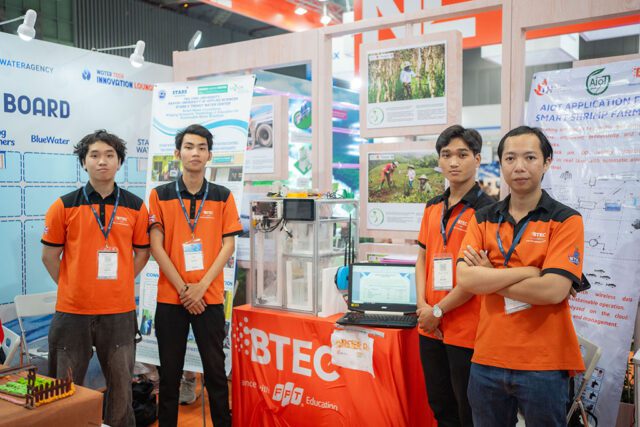
Reinventing Water Monitoring for Safer, Smarter, and More Sustainable Aquaculture
BACKGROUND
Water pollution poses one of the most serious threats to Vietnam’s aquaculture sector. Past industrial wastewater incidents—including Vê Đan (2009), Long Sơn (2015), and Formosa (2016)—led to catastrophic losses, killing hundreds of tons of fish and causing billions of VND in damage. These disasters highlighted a critical gap: aquaculture farmers lacked any reliable and timely method to detect water contamination before it caused irreversible harm.
Traditional water monitoring methods rely on manual sampling, which can take over a week to return lab results—far too slow to protect fish stocks. Meanwhile, imported automated monitoring systems remain inaccessible due to high cost and poor durability in harsh saltwater environments.
Vietnam urgently needs a practical, affordable, and resilient early-warning solution designed specifically for local aquaculture conditions.
MAIN BENEFICIARY
GreenAIoT’s solution directly supports:
- Marine cage fish farmers, who face high vulnerability to sudden water pollution
- Shrimp pond operators, who require continuous real-time monitoring
- Coastal aquaculture communities, often located far from laboratory and technical services
By providing immediate, actionable insights, our system empowers farmers to protect their livelihoods and transition toward safer, more sustainable production.
SOLUTION PROPOSAL
To address this pressing challenge, Team GreenAIoT has developed a dual-system approach that delivers reliable, real-time water quality monitoring tailored for Vietnamese aquaculture environments.
1. Centralized Marine Cage Monitoring Station
- A robust, floating unit designed for offshore fish cage farms, featuring:
- Solar-powered, energy-efficient operation
- Automatic sampling and measurement of key water parameters:
temperature, pH, salinity, chlorine, dissolved oxygen - Industrial-grade, high-precision sensors
- Intelligent sensor protection system: sensors are submerged in a clean water chamber to
- enhance accuracy
- extend sensor lifespan
- minimize calibration needs
- Automatic freshwater cleaning mechanism
- Real-time alerts via SMS, GSM/GPRS, buzzer alarms, and web server notifications
- Multiple communication options: Wi-Fi, GSM/GPRS, Radio
- On-site display for immediate parameter reading
- Integrated automation for pumps, alarms, lights, and gas reducers
Sensor maintenance is required only once every 3 months, reducing downtime and operational cost.
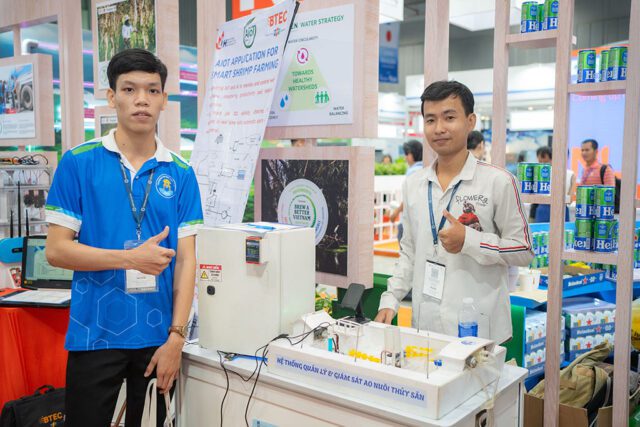
2. Distributed IoT System for Shrimp Ponds
Designed for large-scale ponds, this network deploys intelligent wireless sensors around the site to:
- Continuously monitor environmental changes
- Automatically control oxygenation systems
- Trigger immediate alerts when thresholds are exceeded
- Help farmers prevent fish mortality and optimize electricity usage
Technology Foundation: AIoT for Predictive Safety
Both systems integrate the power of Artificial Intelligence + Internet of Things (AIoT) to:
- Analyze environmental trends
- Predict potential risks
- Provide early warnings before water quality deteriorates
- Support long-term planning and automated farm management
PILOT IMPLEMENTATION
A successful small-scale pilot demonstrated the system’s feasibility, durability, and accuracy under real aquaculture conditions. The results proved GreenAIoT’s potential to transform how Vietnamese farmers detect and respond to pollution threats.
IMPACT
GreenAIoT aims to:
- Prevent large-scale fish mortality by delivering real-time early warnings
- Strengthen farmer resilience against pollution events
- Reduce operational costs through automation and predictive alerts
- Enable sustainable, technology-driven aquaculture practices
- Promote safer production aligned with Vietnam’s environmental goals
See more details on our presentation file below:
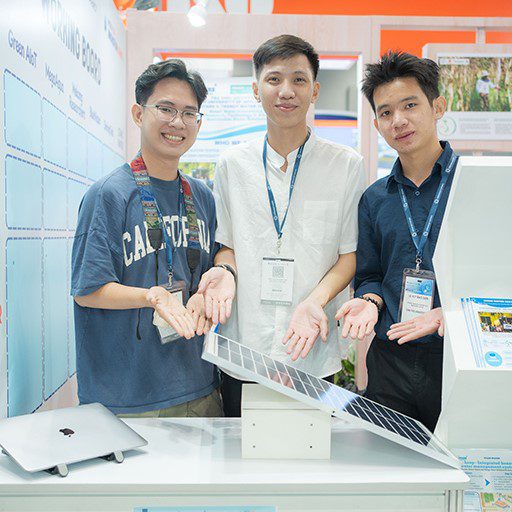
TEAM PROFILE
Mr. Le Nguyen Tri Nhan
- Btech FPT College Student in Ho Chi Minh City (Major in Semiconduct Technology )
- Contact: [email protected]
Mr. Thang Nhat Huy
- Senior student at Ho Chi Minh City University of Industry (Major in Mechatronic Engineering Technology )
- Contact: [email protected]
Mr. Nguyen Thanh Danh
- Melbourne Polytechnic Vietnam Student (Major in Mechatronic Engineering Design)
- Contact: [email protected]