A Sustainable, Efficient, and Scalable Solution for Industrial Water Pollution
BACKGROUND
Textile dyeing wastewater is one of the most challenging industrial effluents to treat due to its complex composition—high concentrations of dyes, organic matter, suspended solids, and heavy metals. Conventional treatment technologies often rely on large quantities of chemicals, produce excessive sludge, and struggle to meet increasingly strict environmental discharge standards.
Small and medium-sized textile facilities, in particular, lack accessible and cost-effective treatment solutions, leading to pollution of waterways and long-term ecological degradation.
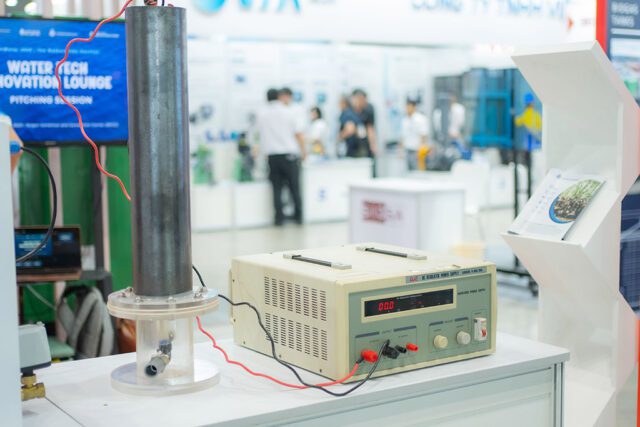
To address this pressing issue, the Blue Water team has developed a laboratory-scale electrocoagulation model that demonstrates a sustainable and efficient approach to treating textile wastewater while reducing chemical consumption and environmental impact.
MAIN BENEFICIARY
The electrocoagulation model benefits:
- Small and medium textile dyeing facilities seeking affordable and effective wastewater treatment
- Researchers and students studying electrochemical water treatment technologies
- Environmental organizations and regulators promoting pollution reduction and cleaner production
By offering a simple yet powerful treatment method, the system supports both industrial application and educational advancement.
SOLUTION PROPOSAL
The core of the Blue Water innovation is a DC-powered electrocoagulation system that uses aluminum or iron electrodes to generate coagulants directly within the wastewater. This eliminates the need for external chemicals and improves treatment efficiency.
How the System Works
- Electrode Dissolution – Coagulant Generation
- When a direct current is applied, the electrodes gradually dissolve, releasing metal ions.
- These ions react with water to form metal hydroxides, acting as highly effective coagulants.
- Pollutant Destabilization
- The in-situ coagulants destabilize dyes, suspended solids, organic pollutants, and heavy metals.
- Contaminants aggregate into larger flocs.
- Separation by Sedimentation or Flotation
- Flocs settle or float, enabling easy separation and removal.
Performance & Advantages
- Removes color effectively
- Reduces COD and BOD
- Captures both organic and inorganic pollutants
- Requires minimal added chemicals
- Produces less sludge than traditional methods
- Simple to operate, adjust, and scale
The system serves as both a research platform to study parameters (current density, pH, retention time, electrode type) and a pilot model supporting future industrial-scale applications.
PILOT IMPLEMENTATION
A small-scale pilot demonstrated the feasibility and strong performance of the electrocoagulation model in real wastewater scenarios. The trials confirmed:
- Excellent removal of dyes and pollutants
- Significant reductions in COD and BOD
- Lower sludge generation compared to conventional chemical coagulation
- Stable operation suitable for scaling to industrial treatment plants
These results highlight the model’s potential to transform wastewater management in the textile industry, especially for smaller facilities facing cost and technology barriers.
IMPACT
Environmental Impact
- Reduces water pollution from textile dyeing effluents
- Protects aquatic ecosystems and public health
- Supports compliance with environmental discharge standards
- Promotes cleaner production practices
Technological Impact
- Low chemical demand and reduced sludge volume
- High treatment efficiency and stable performance
- Easy-to-operate model suitable for upscaling
- Provides a practical demonstration of electrochemical treatment principles
Educational & Research Impact
- Serves as a valuable hands-on teaching tool
- Enables students and researchers to study electrocoagulation mechanisms
- Supports innovation in industrial wastewater treatment technologies
Overall, the system promotes sustainability, cost-effectiveness, and technological advancement, contributing to the transition toward a cleaner, more environmentally responsible textile industry.
See more details on our presentation file below:
TEAM PROFILE
Ms. Huynh Thi Ngoc Han
- Lecturer at Environment Faculty, HCMC University of Natural Resources and Environment
- Contact: [email protected]
Ms. Pham Nguyen Hoai Tran
- Student major in Energy and Environment engineering at HCMC University of Natural Resources and Environment
- Contact: [email protected]
Ms. Nguyen Tieu Bang
- Student major in Energy and Environment engineering at HCMC University of Natural Resources and Environment