Enhancing Climate Resilience and Smart Agriculture in the Mekong Delta
BACKGROUND
The Mekong Delta—Vietnam’s agricultural heartland—faces increasing threats from urban flooding, uncertain water levels, and climate-induced extremes. Communities and farmers often lack real-time information to respond quickly to changing conditions, resulting in preventable losses, reduced productivity, and heightened vulnerability.
Traditional water monitoring methods rely heavily on manual observation, which is slow, labor-intensive, and ineffective during sudden environmental events. Meanwhile, many remote and rural areas cannot depend on stable grid electricity, limiting their ability to adopt digital monitoring solutions.
The Mekong Researchers team has developed a Smart Environmental Monitoring and Early-Warning System tailored specifically for local needs—low-cost, solar-powered, easy to operate, and suitable for deployment across both urban and agricultural landscapes.
MAIN BENEFICIARY
Our solution supports two major user groups in the Mekong Delta:
- Urban households affected by flood risks
Residents in flood-prone areas require timely alerts to prepare and protect their property and safety. - Rice farmers practicing water-intensive cultivation methods
Farmers need automated water-level control to optimize irrigation, improve resource efficiency, and transition toward climate-smart agriculture.
SOLUTION PROPOSAL
The Smart Environmental Monitoring System has been successfully deployed at two pilot sites, serving two distinct but complementary purposes:
1. Early Flood-Warning System for Urban Communities
Location: An Khánh Ward, Ninh Kiều District
Beneficiaries: Urban households affected by frequent flooding
System Functionality
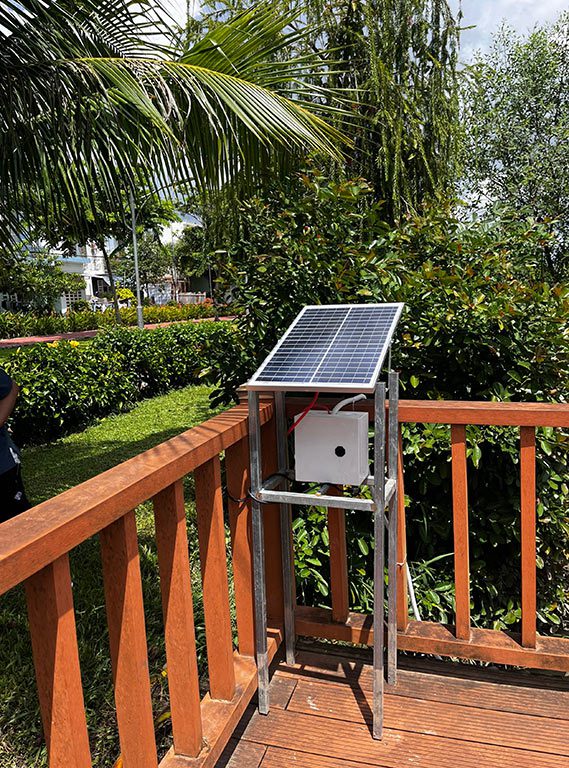
- A solar-powered monitoring device measures water levels using a pressure sensor housed within a protected steel tube anchored in the water.
- Real-time water-level data is transmitted via local household Wi-Fi to a cloud-based management platform.
- The system automatically analyzes fluctuations and identifies dangerous thresholds.
- When water levels rise above safety limits, the system sends instant alerts via a mobile web-app, allowing residents to take early action.
- The solution is fully independent of the national electric grid, ensuring reliability even during storms or power outages.
- This system strengthens community preparedness and reduces the impact of sudden urban flooding.
2. Automated Water-Level Monitoring & Pump Control for Rice Cultivation
Location: Long Thành Commune, Giồng Riềng District, Kiên Giang Province
Beneficiaries: Rice farmers transitioning from traditional to smart, low-emission agriculture
System Functionality
- The monitoring device is installed directly at local irrigation pump stations.
- It continuously measures water levels and automatically operates the pumps based on preconfigured thresholds for the Alternate Wetting and Drying (AWD) irrigation method.
- Farmers and managers can remotely observe water levels and manually adjust pump operation through a user interface.
- The system improves water-use efficiency, stabilizes irrigation timing, and supports farmers in reducing greenhouse gas emissions.
This approach helps modernize rice production practices and strengthens climate resilience in agriculture.
PILOT IMPLEMENTATION
The small-scale pilots in both urban and agricultural settings demonstrate:
- High system reliability in real-world conditions
- Strong community and farmer acceptance
- Improved decision-making through real-time data
- Significant potential for large-scale replication across the Mekong Delta
IMPACT
The Smart Environmental Monitoring and Early-Warning System delivers wide-ranging benefits:
- Enhances climate adaptation by monitoring water levels and alerting communities to flood risks
- Reduces damage and losses for households exposed to urban flooding
- Optimizes agricultural water management and lowers production costs
- Promotes climate-smart farming and supports national greenhouse gas reduction goals
- Expands access to digital technologies in rural and remote areas through solar-powered operations
- Builds valuable environmental datasets to support long-term research, planning, and sustainable resource management
This initiative demonstrates how digital technology, IoT, and renewable energy can transform disaster preparedness and agricultural productivity in the Mekong Delta, contributing to a climate-resilient and sustainable future.
See more details on our presentation file below:
TEAM PROFILE
Mr. Tran Nguyen Hoang Long – Researcher at Mekong Institute, Can Tho University
Contact:
Mr. Nguyen Duc Trung – Researcher at Mekong Institute, Can Tho University
Contact:
Mr. Le Huy Bao Dien – Student at Can Tho University (Major in Cyber Security)
Contact: